

Indonesia Green Economy Index Launched at G20 Side Event in Bali, August 2022
UNPAGE Indonesia - The Ministry of National Development Planning/BAPPENAS launched the Green Economy Index while the world is attempting to recover from COVID-19, tackle the climate crisis, and accomplish zero-emission targets.
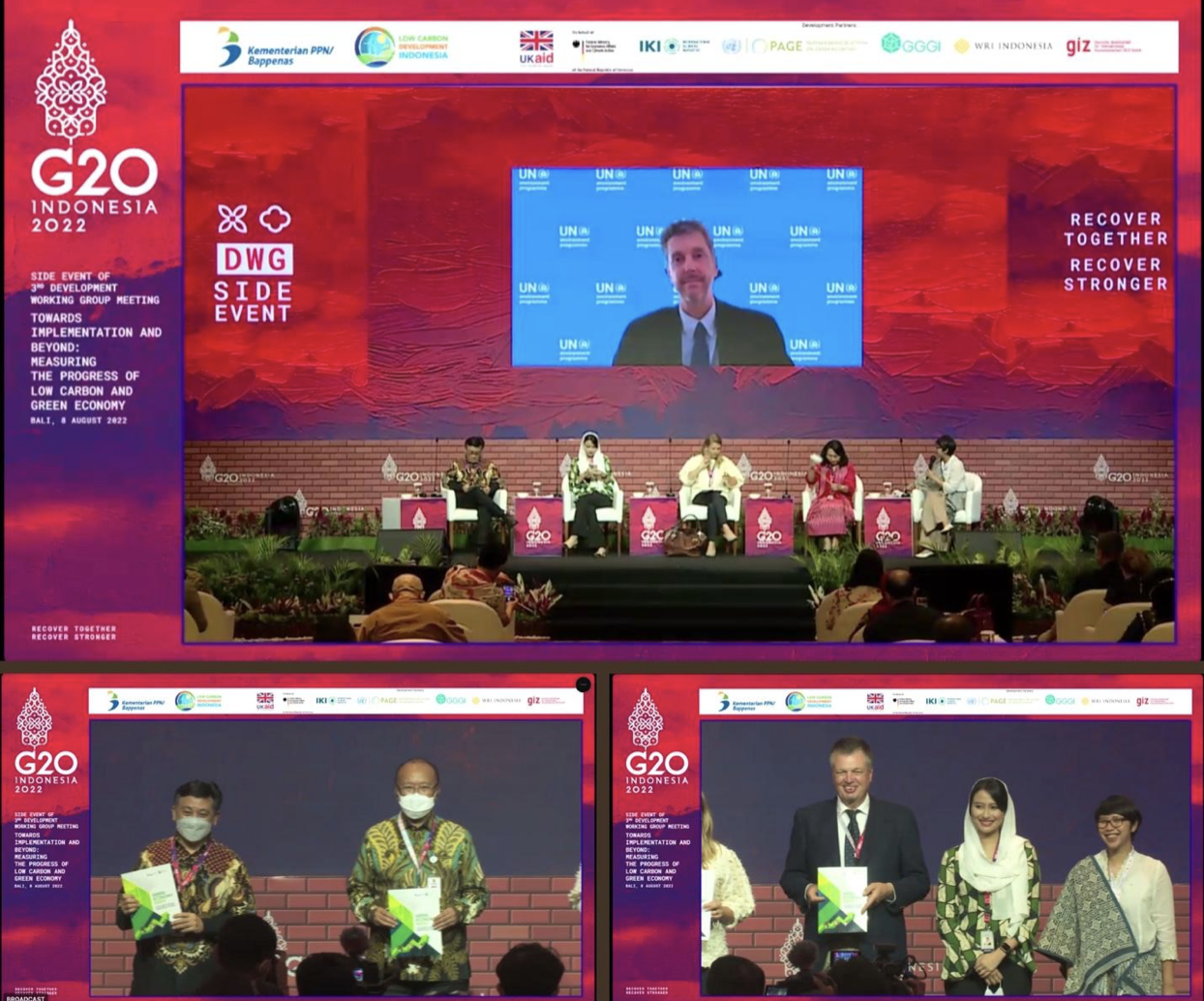
The launch of the Green Economy Index was held in the G20 Development Working Group (DWG) 3rd Meeting Side Event “Towards Implementation and Beyond: Measuring the Progress of Low Carbon and Green Economy”, on August 9th, 2022—a hybrid event.
The transition to a green economy has the potential to boost economic growth and create jobs while hoping to address climate catastrophe and maintain natural carrying capacity. So the existence of a specific measurement index with a concrete representative and a tangible indication of success is required.
“Green Economy Index in nations wide to measure progress made the opportunity in green economy transformation for the future development plan,” UK Ambassador to Indonesia & Timor-Leste, Owen Jenkins said in his opening remarks.
According to Ina Lepel, Ambassador of the Federal Republic of Germany to Indonesia, ASEAN, and Timor Leste, almost $14 trillion has been spent by G20 on the economic recovery. But only around 6% of this expenditure is in line with green recovery.
She said that it is our responsibility as G20, to use this great amount for corrective measures in line with the G20 agenda and Paris Agreement to meet global biodiversity targets and to Build Back Better.
“Green Economy Index can function as an important tool to national progress in the achievement of a low carbon and climate resilient cross-sector development in Indonesia,” Lepel said.
Meanwhile, to implement a green economy with low carbon development and climate resilience as the backbone, Minister of National Development Planning/BAPPENAS Suharso Monoarfa said that we need to start to think about how to keep our green economy agenda on track and how to make sure the progress of it through the Green Economy Index.
“The green economy index also means that we need to navigate Indonesia’s growth to all national development targets and global best practices. As well as realizing to analyze risk and identify policy options to all economic transformation,” he said.
There are 15 indicators in the Green Economy Index, represented by the 3 (three) pillars of sustainable development: economic, social, and environmental. In the ten year period, Indonesia’s Green Economy Index composite score increased from 47.20 (2011) to 59.17 (2020) against all indicators.
“This accomplishment, such as that we are on the track to achieving our goal of developing a green economy,” Chief of Planner of BAPPENAS, Arifin Rudiyanto said replacing Deputy Minister for Maritime and Natural Resources Affairs of BAPPENAS, J. Rizal Primana who was unable to attend.
Director for Environmental Affairs of BAPPENAS, Medrilzam, said that those 15 indicators have been selected with a very careful approach—using the SMART framework. “These indicators are specific, measurable, achievable, relevant, and time-bound.”
However, there are challenges to implementing the Green Economy Index. “We identify at least three major challenges. First, related to the investment in a greener way, we have estimated that our green investment required 3-5% of our GDP. Secondly, on shifting our labor skills. Thirdly, technology, this will be related to a lot of changes in our economic activities,” Medrilzam said during the discussion session.
Given the many challenges, there is a lot of work to be done. “Any kind of issues, any kind of change that we’d like to push needs to go through a particular political process,” LCDI Member of Green Caucus of the Indonesian Parliament House, Dyah Roro Esti said.
“The good news is that this legislation currently being worked on, we hope to see, this year hopefully, not only boosts foreigner direct investment in this field but that can also play field for energy resources,” she said about the parliament working progress in the energy sector.
G20 can play a valuable role. Many countries can learn and be inspired by one another in enabling sharing of experiences and lessons learned. “The launch of the Green Economy Index today is really relevant. It is important to step forward for Indonesia when implementing its green pathways and inspiring others,” Development Director UK-FCDO, Amanda McLoughlin said.
In addition, development and economic growth cannot be separated from potential biodiversity. Funding for nature-based solutions can be allocated for sustainable business. Not only supports the local community but it provides value to why biodiversity matters.
“I think we need to do a simulation of how to do the benefit sharing to the local community,” Senior Researcher at the Indonesia National Research and Innovation Agency/BRIN, Enny Sudarmonowati said.
The launch of the Green Economy Index represents a significant evolution of the concept and the strong political will to carry it forward; and he indicated that technical and technological solutions are already available and being shared, according to Deputy Director, Economy Division of UNEP and Chair of the United Nations Partnership for Action on Green Economy (PAGE) Management Board, Steven Stone.
“The fact that Indonesia with the G20 presidency has put the green economy onto the table of the development working group signals that we need these kinds of solutions and we need to work on them together,” Stone said.
For further information and details, please check the YouTube link below: G20 DWG - TOWARDS IMPLEMENTATION AND BEYOND: MEASURING THE PROGRESS OF LOW CARBON & GREEN ECONOMY
https://eur03.safelinks.protection.outlook.com/...