

Urgency and Overview of Circular Economy Practices in the New Capital City (IKN)
UNPAGE Indonesia - The New Capital City (Ibu Kota Negara Baru/IKN), Nusantara, is expected to become a sustainable city that will drive Indonesia's economy in the future and become a symbol of national identity that represents diversity.
IKN planning and development will put the principle of sustainable livelihoods to maintain the balance of natural ecology, the built environment, and social systems. In this case IKN development also uses the circular concept.
"At this time, we are trying to make an implementation plan, to clarify what must be done in phase 1 in 2022-2024 by compiling 'One Map One Plan One Policy'," said Wicaksono Sarosa, Coordinator of the IKN Transition Expert Team.
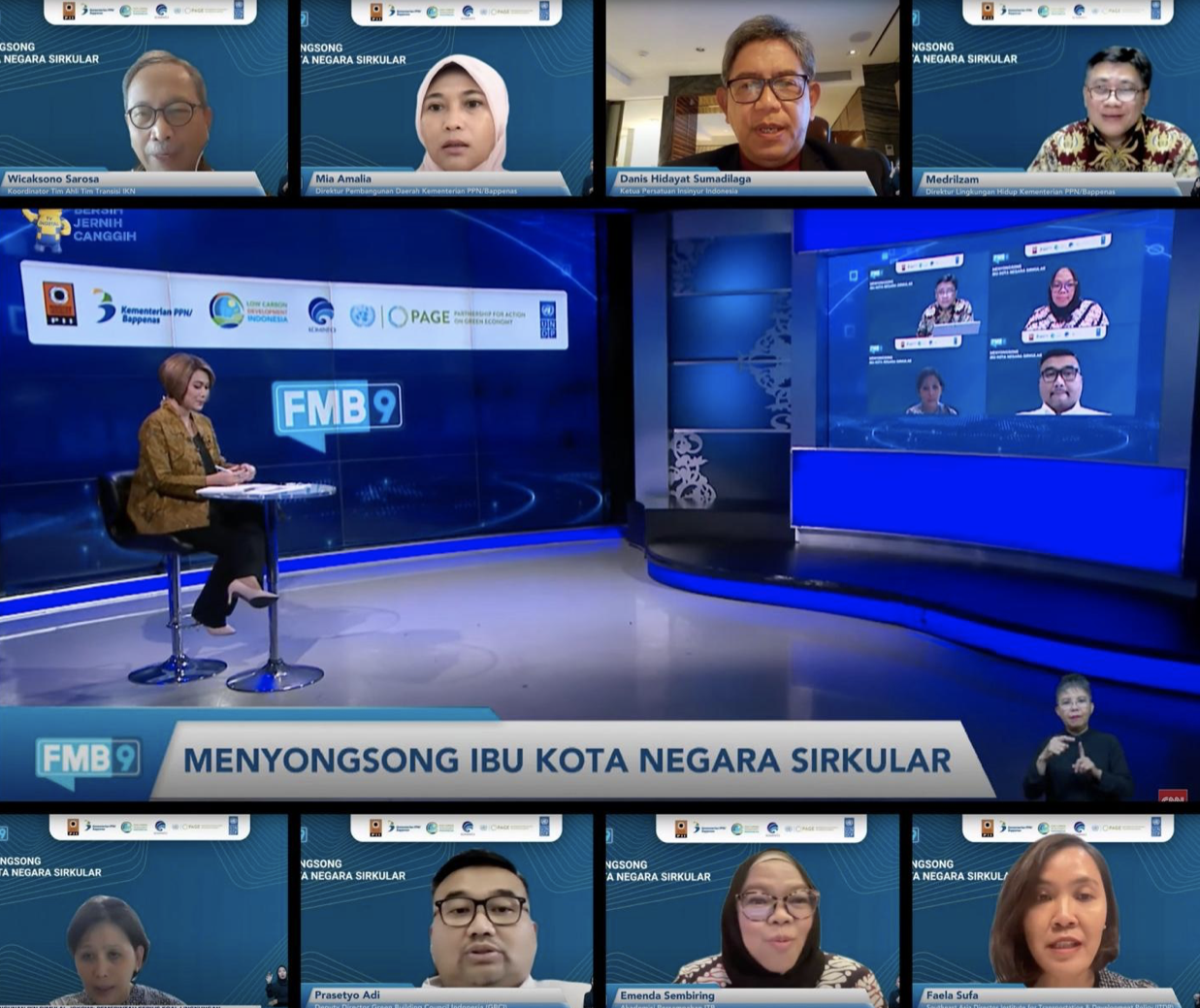
Wicaksono hopes that through the webinar "Menyongsong Ibu Kota Negara Sirkular" which was held on July 28, 2022, it can provide constructive, visionary, innovative, and realistic input for IKN development. This event was organized by Persatuan Insinyur Indonesia/PII, Ministry of National Development Planning/BAPPENAS, Low Carbon Development Indonesia/LCDI Secretariat, and supported by UNDP and PAGE Indonesia.
Mia Amalia, Director of Regional Development of BAPPENAS said that the circular concept was adopted by designing green buildings and implementing a sponge city, combining dynamic open spaces that absorb rainwater and surface runoff. At the same time providing recreational space for the community.
“Building this circular city means promoting the transition from a linear economy to a circular economy throughout the city space. From this transition, it is expected to increase resource efficiency, reduce emissions, and protect & maintain biodiversity. Considering that IKN in the future will be very close to green areas," said Mia.
In line with that, Danis Hidayat Sumadilaga, Chairman of Persatuan Insinyur Indonesia (PII) considers that the circular economy is an important instrument to overcome the current crisis. Especially those related to climate, biodiversity, and pollution. “By keeping natural resources in a longer loop. Of course we will avoid greenhouse gas emissions,” he said.
Circular economy does have various definitions. According to Medrilzam, Director of Environmental Affairs of BAPPENAS, circular economy is how the economic system produces various products, produced by an economic system that are maintained as long as possible in the cycle of production and consumption. Thus reducing natural resources for production and waste that ends up in landfills.
Medrilzam highlights that many approaches in a city are currently not circular. “If we look at the data, the city absorbs 75% of natural resources. In fact, 50% of global waste is generated by cities. 80% of global emissions are also mostly generated from economic activities in cities. Hopefully, by applying two big principles, resource efficiency and minimizing waste from the urban system, a circular city can be developed,” he said.
The circular city through IKN is a big momentum, but it must be accompanied by careful planning. Especially considering Kalimantan with its characteristics as the lungs of the world and its endemic species. Medrilzam said there are three major aspects of circularity related to IKN. "The first is the aspect of building, mobility, and supporting infrastructure (energy, waste, etc.)," he said.
It is important to pay attention to the supply chain to implement a circular economy in a comprehensive and holistic manner. "Especially for IKN, which is still in the initial foundation stage," said Lucia Karina, Chair of the Communication, Media and Awards Committee PII.
The principles that need to be considered related to the supply chain include how IKN utilizes vegetative natural resources in East Kalimantan, utilization of energy resources, waste infrastructure connected to the supply chain, utilization of digital technology, electric transportation modes, and sustainable supply chain in finance.
In addition to the above, green buildings in IKN. It is not only the carbon operations that are important, but also the savings or emission reductions during operations. “What we never count is embodied carbon. Where the number is very large," said Prasetyo Adi, Deputy Director, Green Building Council Indonesia (GBCI).
Regarding the ideal mode of transportation at IKN, we can see it from the geospatial conditions in the core area of the central government, with an average radius of less than 5 km. So, the IKN mobility strategy can be achieved in 5 ways.
Walkable (not prioritizing motorized transportation), transit-oriented development, compact integrated city, electrification of public transportation, and transportation that is integrated with land use.
The division of road space must place pedestrians first and be followed by bicycle lanes.
“We have not seen this in the IKN design that was previously designed. Yesterday, I tried to see the cross-sectional structure of the designed road. 50% is still used for private vehicles on some collector roads, around 43%," said Faela Sufa, Southeast Asia Director of the Institute for Transportation & Development Policy (ITDP).
“Our suggestion is that the planning must implement a transit plaza. where pedestrians as well as public transport can be the main modes of travel. No less important is the provision of a public transport network from the start. This is to encourage the development of transit-oriented cities. If this is not done, the first generation of IKN residents will buy private vehicles,” she continued.
The uniqueness of the circular economy is a multifunctional open space. If it is associated with domestic liquid waste, green open areas can be used as domestic wastewater treatment areas.
"If you look at the design zone, the IKN green zone is up to 70%. We can use it as domestic wastewater treatment. So that it does not return to the environment with negative impacts. At the same time balance the amount of nutrients needed by soil and plants. For example, nutrients in the form of nitrogen, carbon, and potassium that we get from domestic waste," said Emenda Sembiring, ITB Waste Academician.
The implementation of the circular economy principle in urban Indonesia has also begun to be planned at IKN. The implementation of circular economy in IKN has been mandated in the regulation/UU No. 3 Tahun 2022 about State Capital, especially in Article 18 Paragraph 3 which states the need for environmental protection and management through the application of waste and waste management with the principle of a circular economy.